Croissants Are Hard. They're Also Not That Hard. Let's Sort This Out.
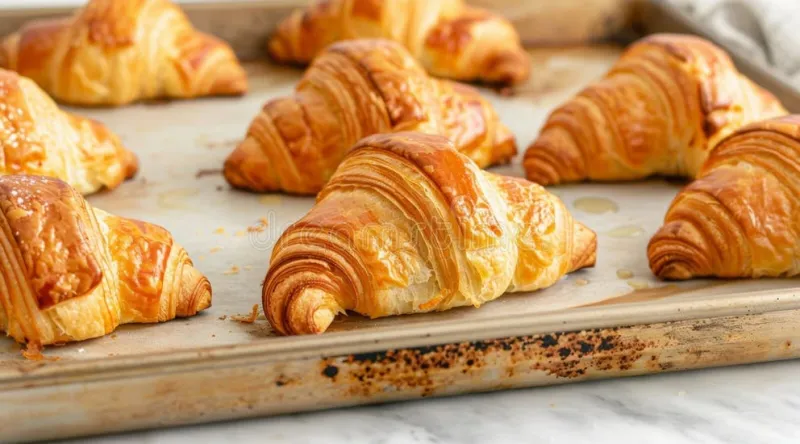
Photo: homemade croissants golden flaky on baking sheet close up, via thumbs.dreamstime.com
Somewhere between Julia Child introducing Americans to French pastry and the rise of the food blogger industrial complex, croissants became a battleground. Not a kitchen project. A battleground. A test of your worth as a human being, your commitment to the craft, your willingness to suffer for flaky, buttery layers that your family will eat in approximately 45 seconds.
We're calling it. The lamination cult has gone too far, and it's time to have an honest conversation about what actually matters when you're making croissants at home versus what the internet has convinced you matters.
First, Let's Acknowledge That Lamination Is Real and Important
We're not going to be completely reckless here. Lamination — the process of folding cold butter into dough repeatedly to create distinct layers — is genuinely the technique that makes a croissant a croissant rather than just a slightly curved dinner roll. The layers trap steam during baking, which puffs everything apart and creates that characteristic honeycomb interior. This is real. This matters.
But here's where things go sideways. The internet has turned lamination into a religion with specific commandments: your butter must be exactly 60°F (not 59°F, not 61°F), your dough must rest for precisely this many hours, your folds must be executed with the geometric precision of an origami master, and if your layers aren't visible from across the room in your cross-section photo, you have failed as a baker and possibly as a person.
This is excessive. This is, in fact, the entire problem.
The Croissant Influencer Pipeline Is Lying to You
Here's something nobody on your baking TikTok feed is going to tell you: most people cannot tell the difference between a croissant with 27 perfect, distinct layers and one with 20 slightly imperfect layers. Not in a blind taste test. Not at a breakfast table. Not under any circumstances involving actual hunger and a warm pastry.
We know this because we tried it. We made three batches of croissants:
Batch A: Full traditional method. 72-hour process. Precise butter temperature management. Three sets of double folds. Rested overnight. The kind of croissants that make French people nod approvingly in your general direction.
Batch B: Simplified method. Same-day dough. Butter temperature managed to "cold but not cracking" rather than a specific number. Two sets of folds instead of three. Four-hour total process.
Batch C: What we're calling the "I have a life" method. Store-bought all-butter puff pastry, shaped into croissants, egg-washed, baked properly.
We served all three to twelve tasters — none of whom were professional bakers — and asked them to rank by taste and texture.
Batch A won. But barely. It beat Batch B by a margin so thin it was essentially statistical noise. Batch C finished third, but six out of twelve tasters said they'd be "completely happy" eating it at a café without questioning its origins.
The 72-hour process produced a marginally better croissant. Marginally. And zero of our tasters were willing to make Batch A at home after we explained the process.
What Actually Matters (And What Doesn't)
Let's break down the croissant variables by actual impact on your final product:
High impact:
- Butter quality. This is non-negotiable. Use European-style butter with higher fat content — Kerrygold, Plugrá, or similar. American butter has more water, which creates steam where you want layers and generally makes everything worse. This is the one place where spending more money genuinely changes the outcome.
- Baking temperature. Too low and you get pale, greasy croissants. Too high and the outside burns before the inside cooks. 375°F to 400°F in a properly preheated oven is your range.
- Egg wash. Two coats. One before proofing, one right before baking. Don't skip the second one. The color and shine you get from a proper egg wash is doing more visual heavy lifting than you realize.
- Proofing. Under-proofed croissants are dense. Over-proofed ones collapse. Your croissants should look noticeably larger and slightly jiggly — like they're just barely holding it together. That's the sweet spot.
Medium impact:
- Number of folds. Two double folds versus three makes a difference you can measure but probably can't taste.
- Rest time between folds. Important, but "30 minutes in the fridge" is a range, not a cliff edge. 25 minutes won't ruin your croissants.
Low impact (but the internet acts like it's everything):
- Exact butter temperature to the degree. "Cold and pliable" is a good enough target. A thermometer is nice. It is not mandatory.
- The specific brand of flour. Bread flour versus all-purpose affects gluten development, but the difference in a home kitchen is subtle.
- The geometry of your cross-section. Nobody eating your croissant is going to cut it in half and examine the layers. They're going to eat it.
The Simplified Method That Actually Works
Here's a same-day croissant process that will produce something you're genuinely proud of:
- Make your dough. Flour, milk, sugar, salt, yeast, a small amount of butter. Mix until smooth. Rest 20 minutes.
- Prepare your butter block. Take 8 oz of cold European butter, pound it between parchment into a roughly 7-inch square. It should be cold but bendable — if it shatters when you fold it, it's too cold. Let it sit five more minutes.
- Encase the butter in the dough. Roll your dough out, place the butter block in the center, fold the dough over it like an envelope. Press the edges to seal.
- Two double folds. Roll out, fold into thirds, rotate 90 degrees, roll out again, fold into thirds again. Wrap and refrigerate 30 minutes. Repeat once more. That's it.
- Roll, cut, shape. Roll to about ¼ inch thick, cut into long triangles, roll from base to tip with gentle tension.
- Proof at room temperature for 2 to 3 hours until noticeably puffed and jiggly.
- Egg wash, bake at 385°F for 18 to 22 minutes until deeply golden.
Will these be identical to what a trained Parisian pastry chef produces after a multi-day process? No. Will they be dramatically, meaningfully better than what most Americans have ever eaten? Absolutely yes.
Stop Letting Perfect Be the Enemy of Buttery
The lamination obsession is, at its core, a performance anxiety problem dressed up as a technique problem. We've been shown so many perfect cross-section photos and 72-hour process videos that anything less feels like failure before we've even started.
But croissants aren't a test. They're breakfast. They're a Sunday project that should leave your kitchen smelling incredible and your family unreasonably impressed. They don't need to be Instagram-worthy. They need to be warm, flaky, buttery, and present.
French bakers aren't actually laughing at your croissant attempts. They're too busy eating croissants. Maybe you should be doing the same.