America, We Need to Talk About How Much Frosting You're Putting on That Cake
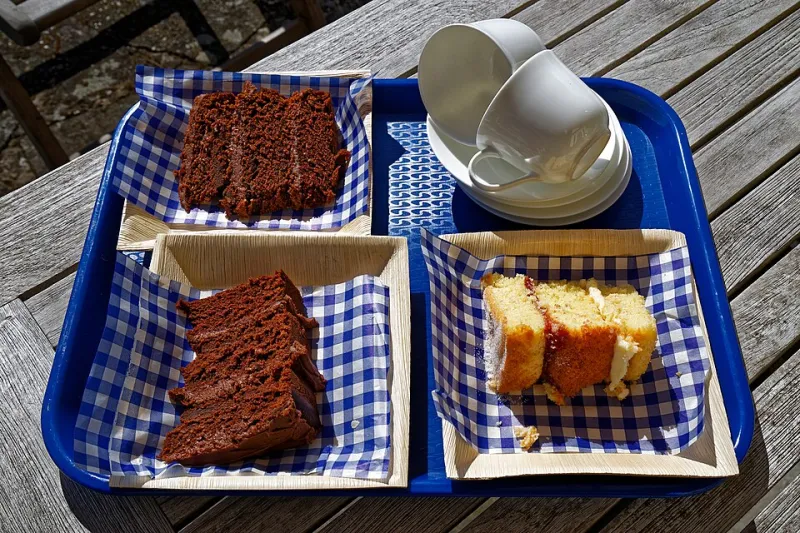
Photo: Acabashi, CC BY-SA 4.0, via Wikimedia Commons
Somewhere along the way, American baking culture made a collective decision that more frosting is always better. That a cake isn't finished until it's wearing a half-inch armor of sweetened butter and powdered sugar. That the ratio of frosting to cake is not a delicate balance but an arms race.
We're here to gently — and then not so gently — push back on that.
This isn't frosting-shaming. We love frosting. Frosting is one of the great achievements of the culinary world. But there's a difference between frosting that enhances a cake and frosting that is the cake, with some sponge hiding underneath it like a witness in protective custody.
How We Got Here
American buttercream — the standard, everywhere-you-look version — is built on a foundation of powdered sugar and butter, often in a ratio of about 3:1 or higher. It's sweet, it's stable, it pipes beautifully, and it holds up in warm rooms. It's also, frankly, aggressively sweet in a way that can bulldoze the flavor of everything underneath it.
Compare that to European approaches: French buttercream uses egg yolks and cooked sugar syrup for a silky, less-sweet result. Swiss and Italian meringue buttercreams use egg whites and cooked sugar, producing a frosting that's light, complex, and actually tastes like butter rather than a sugar cube dipped in more sugar. German buttercream — made with pastry cream — is almost savory by comparison.
None of these are better or worse by default. But the issue isn't just the recipe. It's the quantity. Walk into any American grocery store bakery and pick up a birthday cake. Peel back the lid. Count the frosting layers. We'll wait.
That's a lot of frosting.
The Ratio Problem
A well-balanced cake should have frosting that plays a supporting role. It adds moisture, flavor contrast, and visual appeal. It should complement the crumb, not compete with it.
A good rule of thumb: your frosting should make up roughly 25–35% of each bite. That means on a standard two-layer 9-inch cake, you're looking at about 2–2.5 cups of frosting total — enough for a thin crumb coat and a final layer that actually lets you see the cake underneath.
Most American recipes call for 4–6 cups. For a two-layer cake. That's not a frosting-to-cake ratio. That's a frosting-with-cake ratio.
The result? You slice into a beautiful-looking cake, take a bite, and all you taste is sweet. Just... sweet. The vanilla sponge you spent two hours on? Buried. The brown butter you added for depth? Gone. The cake is a vehicle for sugar delivery, and that's a waste of a good cake.
How to Fix It (The Restrained European Route)
If you want to actually taste your cake, here's how to recalibrate:
Switch to Swiss meringue buttercream. Beat egg whites and granulated sugar over a double boiler until the sugar dissolves, then whip to stiff peaks and add butter gradually. The result is less sweet, more complex, and infinitely more elegant. It also behaves beautifully — smooth finish, great for piping, holds its shape without tasting like a bag of powdered sugar.
Use a thin crumb coat and mean it. A crumb coat is not a practice layer for a thicker coat. It's a sealant. Apply it thin, chill it, then apply your final coat with restraint. You should be able to see the ghost of the cake through a properly done crumb coat.
Try a naked or semi-naked finish. This trend gets mocked, but there's a reason it caught on — it forces you to rely on the cake itself for flavor. If your cake can't stand on its own with minimal frosting, that's the real problem to solve.
How to Fix It (The Maximalist American Route — Done Right)
Maybe you like a lot of frosting. Maybe that's the whole point. That's valid. But even maximalism has technique.
Balance sweetness with fat and acid. Add cream cheese to your American buttercream — it cuts the sugar-forward sweetness and adds depth. A pinch of salt and a teaspoon of apple cider vinegar (sounds weird, works brilliantly) will round out the flavor considerably.
Flavor your frosting like you mean it. Vanilla extract is fine. Brown butter, espresso powder, citrus zest, or a tablespoon of bourbon? Now we're talking. If you're going big on volume, go big on flavor too.
Layer flavors, not just frosting. If you want more between the layers, use a combination: a thin spread of jam or lemon curd, then a modest layer of buttercream. You get the indulgence without the one-note sweetness.
The Cake Beneath the Frosting Deserves Better
Here's the thing: most people who pile on frosting do it because they're not confident in the cake itself. A dry cake needs frosting to compensate. A bland cake needs sweetness to cover it. A dense, gummy cake needs something — anything — to distract from what went wrong.
The real fix isn't less frosting or more frosting. It's a better cake. Nail your sponge — properly creamed, correctly baked, pulled from the oven before it dries out — and the frosting question answers itself. A great cake only needs a little help. A mediocre cake needs to hide.
Frost accordingly.