Why Your Cake Collapses Like a Jenga Tower: The Frosting Physics Nobody Bothered to Explain
Let's paint a picture. You spent three hours baking cake layers, another hour making buttercream from scratch, and approximately forty-five minutes watching YouTube tutorials about how to frost like a professional. You assembled the whole thing with what felt like patience and precision. Then you stepped back, took a breath, and watched your top layer slowly — almost peacefully — slide off the side like it was quitting a job it never wanted.
Congratulations. You've just discovered that frosting is not just a flavor delivery system. It is, structurally speaking, the mortar holding your edible building together. And if you're applying it like you're spreading cream cheese on a bagel at 7 a.m., your cake is going to behave accordingly.
Here's the actual engineering breakdown you didn't know you needed.
Frosting Is Load-Bearing. Treat It That Way.
Professional bakers don't think about frosting as decoration first. They think about it as the bonding agent between layers — and the consistency, temperature, and thickness of that layer matters enormously to whether your cake stands upright or slowly becomes abstract art.
The most common mistake home bakers make is applying filling that's too soft, too thick, or too unevenly distributed. A quarter-inch of filling between layers is the sweet spot for most standard cakes. Go thicker than that and you've created a slip-and-slide situation. Your dense cake layers are now sitting on a cushion of soft fat with nothing to grip. Physics takes over from there, and physics does not care about your birthday party timeline.
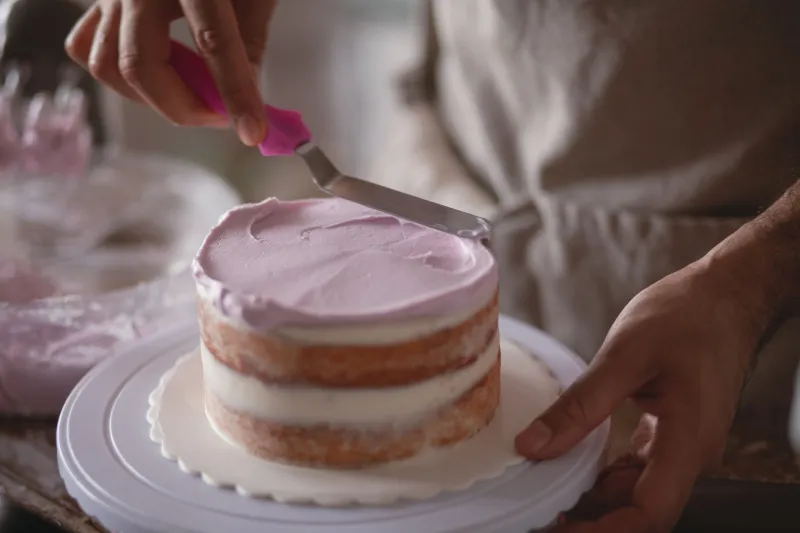
When you spread your filling layer, use an offset spatula and work from the center outward with consistent, even pressure. You're not smearing. You're packing. There's a difference. Press down lightly with the flat of the spatula as you go to push out air pockets and create a surface that actually bonds to the next layer when it lands.
The Cold Cake Rule Is Not Optional
Here's where most people shortcut themselves into disaster: warm cake layers. You pulled them from the oven, let them cool for what felt like a reasonable amount of time, and then started stacking because you're impatient and the frosting is right there.
Warm cake does two catastrophic things. First, it melts your frosting on contact, turning your carefully prepared buttercream into a greasy liquid that lubricates the very slide you're trying to prevent. Second, warm cake is still releasing steam, which means the crumb structure is soft and compressible in ways that make it unstable under weight.
Your layers need to be fully cooled — room temperature at the absolute minimum, and refrigerator-cold if you're working in a warm kitchen or dealing with a particularly tall cake. Cold layers grip frosting. Cold frosting grips cold layers. That's the whole game.
The Crumb Coat Is Structural, Not Cosmetic
If you think the crumb coat is just a thin smear of frosting to trap stray crumbs before the pretty coat goes on, you're missing about sixty percent of what it actually does.
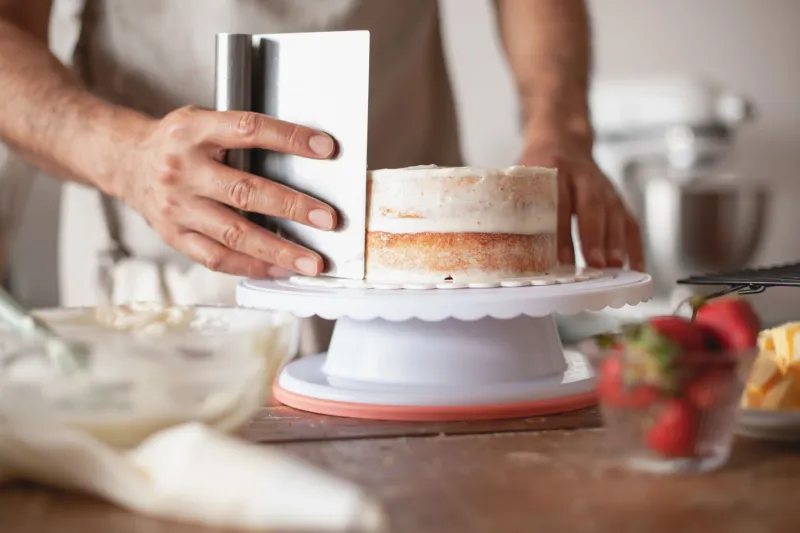
A proper crumb coat — applied thin, worked into the surface, and then fully chilled before you continue — creates a unified shell around your stacked layers. It locks them together. It gives the outer frosting something to adhere to that isn't raw cake crumb. And critically, it firms everything up so that when you apply pressure during final frosting, you're not deforming the shape you worked to build.
The key is chilling after the crumb coat. Thirty minutes in the refrigerator minimum. You want that layer to go from soft and pliable to firm and set before any additional frosting goes on. If you skip this step or rush it, you're applying your final coat to a surface that's still moving, and the whole structure remains unstable until it's fully chilled again — which may be after it's already started leaning.
Pressure Points: Where Cakes Actually Fail
Understand this: cakes don't fail uniformly. They fail at specific pressure points, and those points are almost always the same ones.
The edge of each layer is where the most structural stress lives. When you stack a layer, the weight of everything above it pushes down and slightly outward at the perimeter. If your filling extends all the way to the edge — or worse, over it — you've created a hydraulic situation where that filling is being squeezed outward under load. The layer above has no stable perimeter to sit on.
Professional bakers leave a small gap — roughly a quarter inch — between the filling and the edge of the cake. When the next layer is placed and pressed down gently, the filling migrates slightly toward the edge and fills that gap, creating a seal without overflow. That's not an accident. That's intentional pressure management.
When you're placing each layer, don't just drop it. Set it down from one edge and lower it gradually, then press down with flat palms across the whole surface. Even pressure across the full diameter distributes the weight properly and prevents one side from sinking lower than the other.
Temperature Management During Assembly
Your kitchen temperature is either working for you or against you, and most home bakers have no idea which one it is.
Buttercream begins to soften noticeably above 70°F. If your kitchen is running warm — which, during summer in most of the US, it absolutely is — your frosting is fighting a losing battle against gravity and ambient heat the entire time you're working. The fix is simple but requires accepting that baking sometimes involves your refrigerator as a tool, not just a storage unit.
Work in stages. Stack two layers, chill. Add the next layer, chill. Crumb coat, chill. Final coat, chill. Yes, this takes longer. No, there is no shortcut that produces the same result. Every time you pull the cake out of the refrigerator, you have a limited working window before heat softens things again. Respect that window.
If you're working with a Swiss or Italian meringue buttercream — the silky, less-sweet versions — your tolerance for warm temperatures is even lower. These frostings are more sensitive to heat than American buttercream and will go glossy and soft faster. Keep your workspace cool, keep your frosting in the refrigerator between uses, and work quickly.
The Dowel Conversation You've Been Avoiding
For cakes taller than three standard layers, or any cake that needs to travel, you should be using dowels or straws through the center. This is not a professional-only technique. It's a load-bearing physics solution available at any craft store for about four dollars.
A center dowel run through all layers eliminates horizontal movement entirely. The layers can still compress slightly, but they cannot slide. For a two-layer birthday cake, you probably don't need one. For a four-layer celebration cake that's going in a car? You absolutely do, and no amount of frosting technique will substitute for it.
The Bottom Line on Cake Stability
Your cake isn't structurally compromised because you're a bad baker. It's compromised because nobody ever explained that assembling a layer cake is closer to construction than it is to arts and crafts. Temperature, pressure, adhesion, load distribution — these are the variables that determine whether your cake arrives at the table intact or gets scooped off the plate in a heap.
Treat your frosting like it matters to the structural integrity of the thing, because it does. Chill your layers. Manage your filling depth. Respect the crumb coat. Control your kitchen temperature. Do all of that, and you'll build cakes that stay exactly where you put them — which is, ultimately, the only goal that actually matters.