The Leaning Tower of Cake: Why Your Layers Are Crooked and Your Gadget Drawer Is the Problem
Let's just say it out loud: your cake layers are uneven, your frosting is doing structural load-bearing work it was never designed to do, and somewhere deep in your soul, you know a $40 cake leveler isn't going to fix this.
And yet — there you are, hovering over a baking subreddit at midnight, watching a video of someone dragging a wire contraption through a lopsided chocolate cake like they're performing surgery. You're nodding along. You're adding it to your cart. You're wrong.
The uneven cake layer problem is one of the most misdiagnosed frustrations in home baking, and the baking industry has done a spectacular job of selling you solutions to symptoms instead of cures for the actual disease. So let's do this properly.
The Dome Is Not Your Enemy. Your Oven Is.
Here's the thing nobody tells you when you're standing there staring at a perfectly domed cake like it personally offended you: that dome is your oven talking. Specifically, it's your oven's hot spots having a conversation you weren't invited to.
Most residential ovens — yes, even your nice one — run hotter in the back and cooler near the door. The heating element cycles on and off throughout the bake, which means the edges of your cake hit high heat in bursts while the center plays catch-up. The result? The edges set and climb fast, the center keeps rising after the edges have already committed to their shape, and you get a dome that looks like a tiny mountain range.
Before you blame your pans, your recipe, or your general competence as a human being, go buy an oven thermometer. A cheap one. Put it in the center of your oven and set the temperature to 350°F. I'll wait. Whatever it reads — and I'd bet money it's not 350°F — that number is more useful than any cake strip you've ever purchased.
The Rotation Problem Nobody Talks About
You've heard "rotate your pans halfway through baking" so many times it's become white noise. But here's the actual nuance that gets lost in translation: when you rotate matters enormously, and most people are doing it either too early or too late.
Rotate too early — say, at the 10-minute mark when your batter is still liquid in the center — and you're just moving the problem around. The cake hasn't set enough to hold its structure, so the batter sloshes, the rise gets disrupted, and you've accomplished nothing except opening the oven door and letting out heat like it's free.
Rotate too late — when the cake is already 80% done — and you're rotating a dome that's already locked in. Congratulations, it's now a dome facing the other direction.
The sweet spot for most standard cake layers is right around the halfway mark, when the edges are visibly set and pulling away slightly from the pan sides, but the center still has a little jiggle. At that point, rotation actually does something. It evens out the heat exposure during the critical final rise, and you'll notice a real difference in how the top sets.
Your Batter Distribution Is Lazy and You Know It
Okay, real talk. A lot of "uneven layer" problems aren't oven problems at all. They're batter problems. Specifically, they're the result of pouring batter into a pan and calling it a day without actually distributing it evenly.
Batter is thick. It doesn't self-level like water. If you dump it in the center and give it a gentle shimmy, you're going to end up with more batter in the middle than the edges — which means the middle rises higher, which means you're back to dome city.
Use an offset spatula (one of the few baking tools actually worth owning) to spread the batter from the center outward in a thin, even layer, and then do something counterintuitive: push slightly more batter toward the edges of the pan than the center. Not a lot. Just a little nudge. The center will catch up during baking, and you'll end up with a much flatter top.
While you're at it, weigh your batter if you're making multiple layers. A kitchen scale costs about $12 and will change your life more than any cake leveler ever could. Split the total batter weight evenly across your pans and you'll never have one thick layer and one embarrassingly thin layer again.
The Cake Strip Situation
Fine. Let's talk about cake strips — those fabric strips you soak in water and wrap around your pan to slow down the edge baking. Do they work? Kind of, sometimes, in certain conditions, with certain recipes.
Here's the honest breakdown: cake strips slow down the edges so they set at a more similar rate to the center. In theory, this reduces doming. In practice, they also extend your bake time, can lead to a slightly denser texture near the edges, and require you to remember to soak them before you start baking, which — let's be real — is not always happening.
If your oven is well-calibrated, your batter is distributed properly, and you're rotating at the right time, you don't need cake strips. They're a workaround for a problem you could solve upstream. If your oven is a disaster zone and you've tried everything else, sure, throw the strips on. But don't let them be your first move.
So Do You Ever Actually Need to Level?
Yes. Sometimes you will still need to level a cake, and that's fine. Life isn't perfect. Neither is baking.
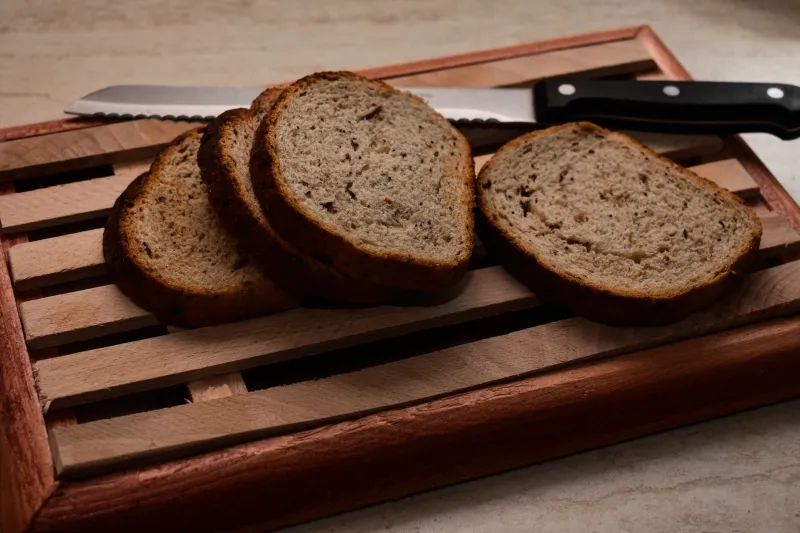
But here's the thing about leveling: you don't need a special tool. You need a long serrated bread knife and a steady hand. Set the cake on a flat surface, find the lowest point of the dome, and use that as your guide. Hold the knife parallel to the counter, not angled up toward you like you're trying to saw through something. Use a gentle sawing motion with almost no downward pressure. Let the blade do the work.
The goal is one smooth pass, not twelve nervous little cuts that turn your cake layer into a cratered moonscape. If you're struggling with consistency, stick a toothpick into the side of the cake at the height you want to cut — use it as a visual guide and keep the knife at that level.
That's it. That's the whole technique. No $40 contraption required.
The Actual Checklist
If you want flatter cake layers without losing your mind, here's the no-nonsense version:
- Get an oven thermometer. Know your actual oven temperature before you bake anything.
- Distribute batter with an offset spatula, pushing slightly more toward the edges.
- Weigh your batter when making multiple layers so they're actually the same size.
- Rotate halfway through, when edges are set but the center still has movement.
- Level with a bread knife if needed — slow, steady, parallel to the counter.
Your cake layers can be flat, even, and structurally sound without a single specialized gadget. The oven is the variable most people ignore because it's not as satisfying as buying something new. Fix the oven situation first. Everything else is just noise.