The No-Knead Bread Lie You Keep Falling For (And Why Your Loaf Is a Soggy Disappointment)
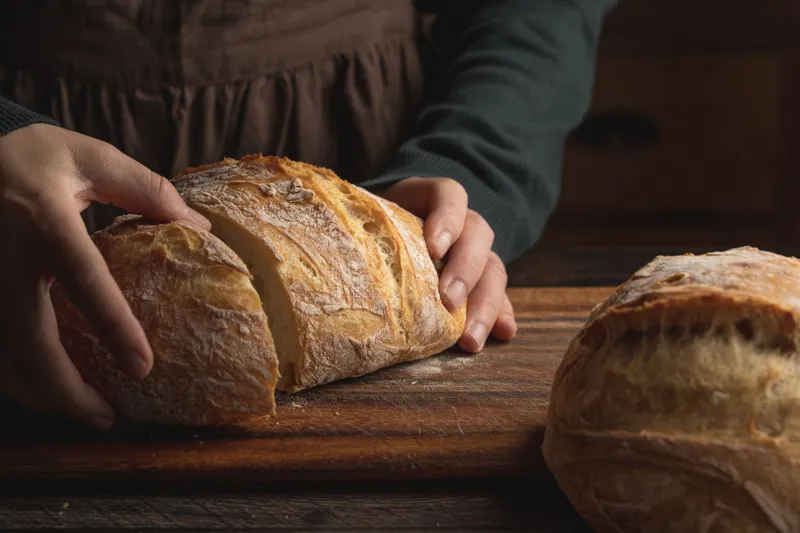
Let's talk about the greatest piece of food marketing since someone convinced America that margarine was basically butter. No-knead bread showed up in the mid-2000s like a messiah in a Le Creuset, promising crusty, open-crumbed loaves with nothing more than a bowl, a spoon, and the patience of a golden retriever waiting for dinner. Blogs lost their minds. Food editors wept happy tears. Home bakers across the country shoved their stand mixers to the back of the cabinet and declared themselves artisans.
And then they ate the bread.
You know what happened. Dense crumb. Gummy interior. A crust that sounds dramatic when you tap it but lies about everything underneath. You blamed the flour. You blamed your oven. You blamed your Dutch oven, your altitude, your tap water, your general unworthiness as a human being. But here's the thing — none of that is the actual problem.
The problem is that "no-knead" was never quite telling you the whole truth.
What "No-Knead" Actually Means (Hint: It's Not What You Think)
Gluten development is non-negotiable. Full stop. You cannot make a structurally sound, properly textured loaf of bread without it. Gluten is the protein network that traps gas bubbles from your yeast, holds the dough together during baking, and gives bread that satisfying chew that separates it from a dinner roll's sad cousin.
Here's the thing about no-knead recipes: they don't actually skip gluten development. They outsource it. A long, cold, slow fermentation — typically 12 to 18 hours — allows gluten to develop on its own through a process called autolyse and time-assisted hydration. The gluten strands align and strengthen gradually without you having to touch the dough. So technically, yes, you're not kneading. But the work is still happening. The bread is still doing what bread needs to do.
The problem is that most people don't let it do that work properly.
The Shortcuts You're Taking Inside the Shortcut
No-knead recipes attract a very specific type of baker: someone who wants great results with minimal effort. That's not a criticism — that's called being a rational adult with a full schedule. But the irony is that those same people tend to cut corners inside an already stripped-down process, and that's where everything goes sideways.
Are you doing a 12-hour cold ferment or a 2-hour room temperature rush job because you decided at 4pm that you wanted bread with dinner? Are you using whatever flour was left in the back of your pantry, including that bread flour you bought two years ago that smells faintly of your pantry shelf? Are you skimping on the resting period after shaping because you're impatient and the Dutch oven is already hot?
Every one of those decisions compounds. No-knead bread has almost no margin for error because you've already removed the primary mechanism — physical kneading — that would otherwise compensate for sloppy handling. When you knead dough, you're actively building and aligning gluten. When you skip kneading, time and temperature become your tools, and if you mess with those, you've got nothing left.
The High Hydration Problem Nobody Warned You About
Most no-knead recipes are high hydration by design — often 75% to 80% water relative to flour. This is intentional. Higher hydration makes gluten development easier during that long ferment and contributes to the open, airy crumb that makes artisan bread look like it belongs on a brunch table in Brooklyn.
But high hydration dough is also merciless. It punishes you for every mistake. Shaping it is harder. It's stickier, more temperamental, and more likely to spread sideways instead of rising upward if your gluten network isn't properly developed. That gummy, dense interior you keep getting? That's what happens when high hydration dough hits the oven without adequate gluten structure. The water has nowhere organized to go. It steams unevenly. The crumb sets before it can open up properly. You end up with a loaf that looks fine on the outside and lies to you completely.
Your Dutch Oven Is Not the Problem, But It's Also Not Saving You
Every no-knead recipe on the internet tells you to use a Dutch oven, and for good reason — it traps steam during the first part of baking, which keeps the crust pliable long enough for the loaf to fully expand before it sets. It's genuinely useful. It's not magic.
You cannot use a Dutch oven to rescue dough that hasn't developed properly. The Dutch oven is a delivery system. It creates the right environment for a well-made loaf to express itself. If your dough is under-fermented, over-proofed, or structurally weak, the Dutch oven is just going to give you a very expensive container for your disappointment.
Also — and this matters more than people admit — you need to preheat that thing. A cold Dutch oven going into a hot oven is not the same as a screaming-hot Dutch oven receiving your dough. The initial burst of heat from the bottom of a preheated vessel is what drives oven spring. Skip that, and your loaf sits there warming up slowly instead of launching.
So What Do You Actually Do?
First, take the time commitment seriously. If the recipe says 12 to 18 hours, that's not a suggestion range where 6 hours is close enough. Set it up before you go to bed. Ferment it in the fridge overnight. Give the gluten time to do the job you're asking it to do without your hands.
Second, use bread flour. All-purpose works in a pinch, but bread flour has higher protein content, which means more gluten potential. If you're already skipping the kneading, you want every structural advantage available to you.
Third, don't skip the bench rest after shaping. That 20 to 30 minutes of rest before the final proof isn't filler — it's the gluten relaxing so the dough can hold its shape in the oven instead of spreading out like it's trying to escape.
And finally, if your bread keeps coming out gummy in the middle, pull out a thermometer. The interior of a fully baked loaf should hit around 200 to 210°F. Not 190°F. Not "it looks done." Stick the thermometer in and know.
The Honest Takeaway
No-knead bread isn't a scam. It's a genuinely clever technique that makes real artisan-style bread accessible to home bakers who don't want to spend an hour working dough by hand. But it was sold to you as effortless, and it's not. It's just differently effortful — the effort lives in patience, precision, and actually following the instructions instead of treating them as loose guidelines.
The bread can be incredible. Crackling crust, open crumb, the kind of loaf that makes you feel like you know something other people don't. But you have to respect the process, even when the process looks deceptively simple. Especially then.
Bread doesn't care about your schedule. Bread cares about time and temperature and gluten. Work with those, and the loaf you've been chasing is absolutely within reach. Keep taking shortcuts inside your shortcut, and you're going to keep making expensive, gummy frisbees and wondering what went wrong.
You know what went wrong. Now go fix it.